
TRACE
A safe community app for transgender and non-binary individuals
10K+
Users reached before sunset
$350K
Raised in capital via Beloit gBETA
100%
Of surveyed users wanted an app solution
The Challenge
Transgender and non-binary individuals navigating their transition lack a centralized, safe space for community support, HRT photo tracking, and resource access. Existing tools were either clinical and cold, or general social platforms with inadequate safety features.
Approach
As the sole designer on a co-founded product, I owned every layer of the experience — from early research through final UI. Conducted user interviews and surveys to understand real needs around HRT tracking, privacy, and community safety. Developed user flows, wireframes, and prototypes in Sketch, Figma, and InVision, with accessibility, privacy, and user empowerment as foundational constraints throughout.
The App
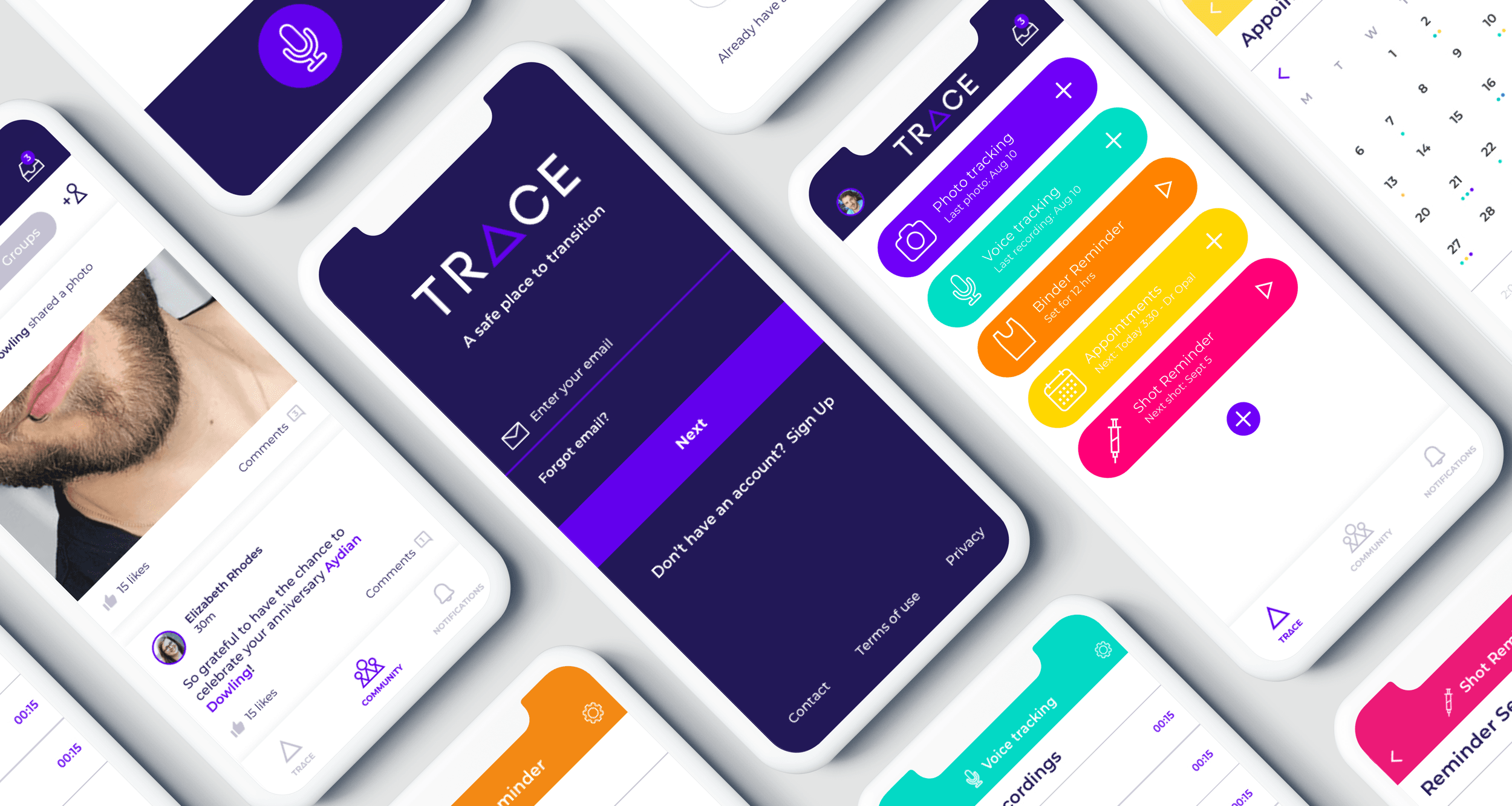
TRACE is built around three core pillars: HRT photo tracking, community connection, and flexible privacy controls. Every screen was designed to feel welcoming and affirming — the opposite of the clinical or indifferent tools the community had been making do with.
Research & Ideation
We started with deep user research — interviews, surveys, and synthesis to understand the real needs of transgender and non-binary individuals navigating their transition. That informed a feature prioritization exercise and a detailed information architecture before a single pixel was designed.
The Insight That Changed Everything
Early research confirmed what we suspected: existing tools were clinical, cold, or unsafe. But one finding reframed the entire product vision. When we surveyed users and went deeper into community research, it became clear that a tracking app alone wasn't enough. Trans people — especially youth — needed connection as much as they needed features. The data that stopped us in our tracks: a trans child with just one supportive person in their life is 50% less likely to attempt suicide. That's not a feature request. That's a design mandate. Community wasn't a nice-to-have we'd add later. It had to be foundational — built in from the start, alongside tracking, not bolted on after.
Wireframes & Flows
From hand-drawn sketches to detailed wireframes and task flows, we mapped every user journey with care — particularly around sensitive moments like first-time setup, privacy settings, and community interactions.
Hi-Fidelity Screens
Moving from wireframes to high-fidelity — bringing the brand and interaction design together. Every screen was built to feel welcoming and affirming, with clear hierarchy, accessible color, and a tone that treated users as whole people.
Usability Testing
We ran moderated usability sessions and synthesized findings using structured analysis. Testing surfaced key friction points — particularly around photo tracking setup and community privacy settings — that we iterated on before beta launch.
Original Illustrations
Every illustration in TRACE was hand-drawn by Elizabeth — before AI, before tools, just a drawing tablet and an intent to make the app feel human. The characters represent the full spectrum of our community: diverse bodies, expressions, and identities. These weren't stock art. They were made with love.
Outcome
Reached 10,000+ users. Accepted into the Beloit gBETA accelerator and raised $350K in capital. Featured in 'The Best Simple App Designs' by Design Rush. We made the deliberate decision to sunset the app in 2024 — protecting our users' sensitive data given the political climate around transgender rights.
10K+
Users reached before sunset
$350K
Raised in capital via Beloit gBETA
100%
Of surveyed users wanted an app solution
Co-founded with Aydian Dowling (Trans activist & co-founder) and Taylor Greene (Developer & co-founder)